SIMAGIC
8.2/10
SIMAGIC P1000 Pedals Review: A Twelfth of the Price of an Active Pedal
SIMAGIC P1000 Pedals Review: A Twelfth of the Price of an Active Pedal

The Alpha Evo range is the strongest price-to-feel argument in direct drive right now. Independent testers consistently place its force feedback quality above what the price bracket normally buys, and in the same conversation as bases costing considerably more. The deductions are not about the motor. They are about the things bolted around it: plastic panels on an otherwise aluminium body, a front mount that used to be included and now is not, and a documented pattern of vibration complaints following firmware updates. Buy it for the motor and the encoder. Budget for the mount, and read the firmware section before you update anything.
16 min read · Last updated 5 September 2026
How this review was put together. WheelVerdict did not receive an Alpha Evo sample from SIMAGIC. This review is a synthesis: manufacturer documentation and published specifications, cross-referenced against independent hands-on testing from Boosted Media, OC Racing, TweakTown and SimRacingSetup, then weighed against owner troubleshooting reports and community failure threads. Every number below traces back to a source, and where reviewers disagree, that disagreement is stated rather than smoothed over. Nothing here is presented as first-hand bench testing.
Direct drive used to have a floor of around $700 for the base alone. The Alpha Evo range put a 9 Nm servo base at $399 and an 18 Nm one at $699, which is roughly what the previous generation cost for less motor and an older encoder.
That is the interesting part. Hardware normally gets more expensive. SIMAGIC went the other way, added a 21-bit encoder, redesigned the motor, and still cut the entry price.
There is a catch, and it is not the one most buyers expect.
| Category | Weight | Score |
|---|---|---|
| Specs for the price | 35% | 92 |
| Compatibility | 25% | 68 |
| Community consensus | 25% | 80 |
| Support and warranty | 15% | 65 |
| Overall | 7.9 / 10 |
Weighted score. Synthesised from 9 independent sources; evidence tier: specification analysis, not hands-on testing.
Compatibility: PC only. No Xbox, no PlayStation, no exceptions.
The Alpha Evo range is the strongest price-to-feel argument in direct drive right now. Independent testers consistently place its force feedback quality above what the price bracket normally buys, and in the same conversation as bases costing considerably more.
The deductions are not about the motor. They are about the things bolted around it: plastic panels on an otherwise aluminium body, a front mount that used to be included and now is not, and a documented pattern of vibration complaints following firmware updates.
Buy it for the motor and the encoder. Budget for the mount, and read the firmware section before you update anything.
Links below go to official brand and product pages. Pick the torque tier before you pick the retailer, because the three variants are genuinely different products rather than trim levels.
| Variant | Torque | Who it suits | Link |
|---|---|---|---|
| Evo Sport | 9 Nm | First direct drive base, smaller rigs, mixed-discipline racing | SIMAGIC product page |
| Evo | 12 Nm | The default pick, enough headroom for GT3 without needing a rigid rig | SIMAGIC product page |
| Evo Pro | 18 Nm | Formula and prototype cars, aluminium profile rigs only | SIMAGIC product page |
| Evo Ultra | 28 Nm | Separate flagship, different value equation entirely | SIMAGIC official site |
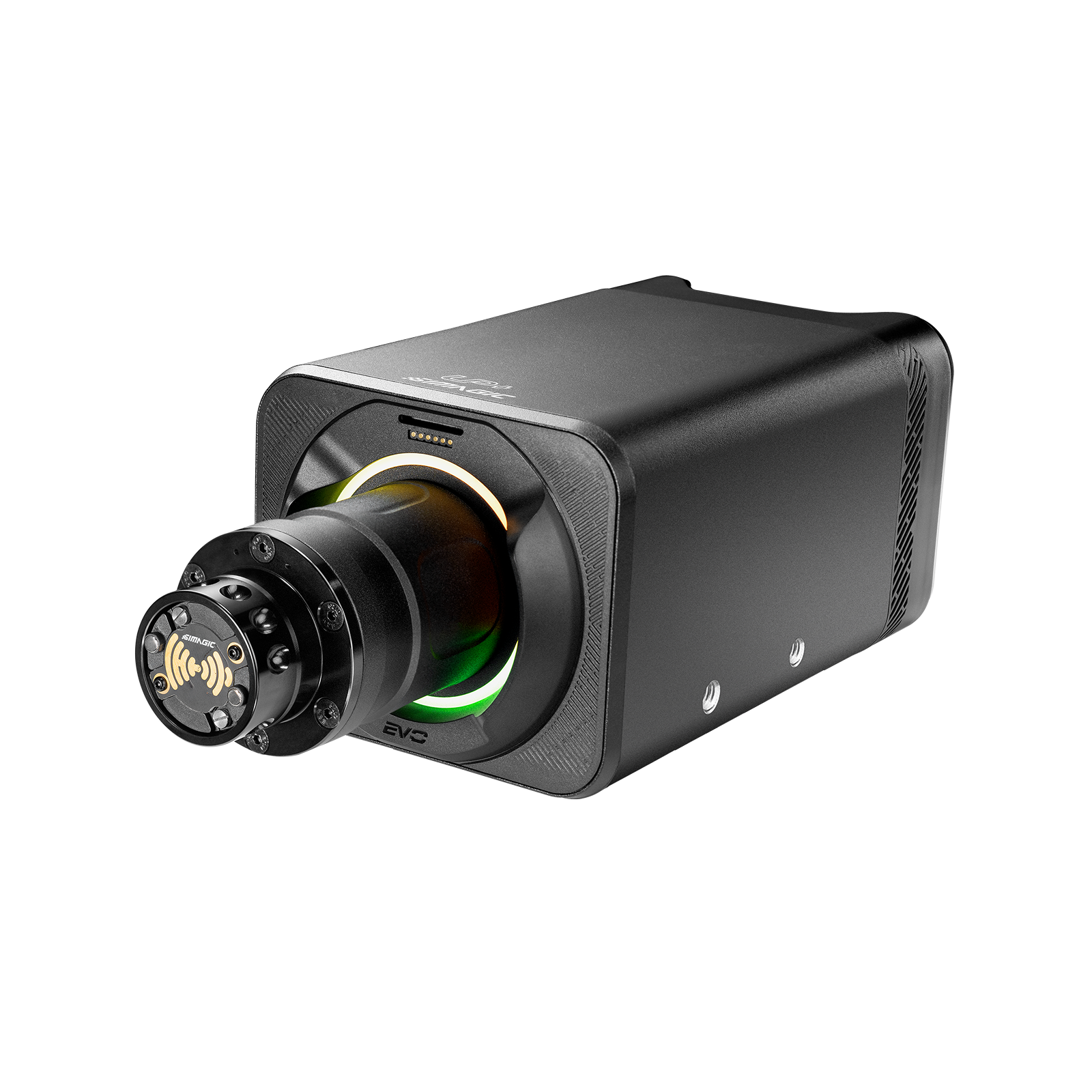
Worth pricing at the same time: the front mount adapter, a quick release if you plan on third-party wheels, and a rig that can actually hold the torque tier you chose.
| Variant | USD | GBP (inc VAT) |
|---|---|---|
| Evo Sport 9 Nm | $399 | £427 |
| Evo 12 Nm | $549 | £577 |
| Evo Pro 18 Nm | $699 | £731 |
| Evo Ultra 28 Nm | $969 | Check retailer |
Euro pricing varies enough between SIMAGIC distributors that quoting a single figure would be misleading. Check your regional reseller directly. Prices verified 5 September 2026 and they move, particularly around bundle promotions.
The headline is the motor. SIMAGIC moved to a custom-designed 5-pole servo with low-inertia characteristics, and the practical result reported across independent testing is reduced torque ripple and less cogging than the outgoing Alpha bases.
Cogging is worth explaining, because it is the thing that separates a good direct drive base from a merely powerful one. A servo motor has magnetic poles, and as the rotor turns past them there is a natural tendency for it to want to settle into detents. You feel it as a faint notchiness when you turn the wheel slowly with the power off, and in motion it shows up as texture that is not coming from the car. Lower inertia in the rotor means the motor changes direction faster and adds less of its own character to the signal.
The second change is the encoder. The Alpha Mini used an 18-bit unit. The Evo uses 21-bit, which is eight times the angular resolution. In practice that governs how finely the base can resolve small steering inputs, which matters most in the few degrees either side of centre where a lot of GT and formula driving actually happens.
The third change is less flattering. SIMAGIC removed the integrated front mount and now sells it as an accessory. Reviewers have flagged that the adapter also adds width, which can create clearance problems on rigs that were sized tightly around the previous generation.

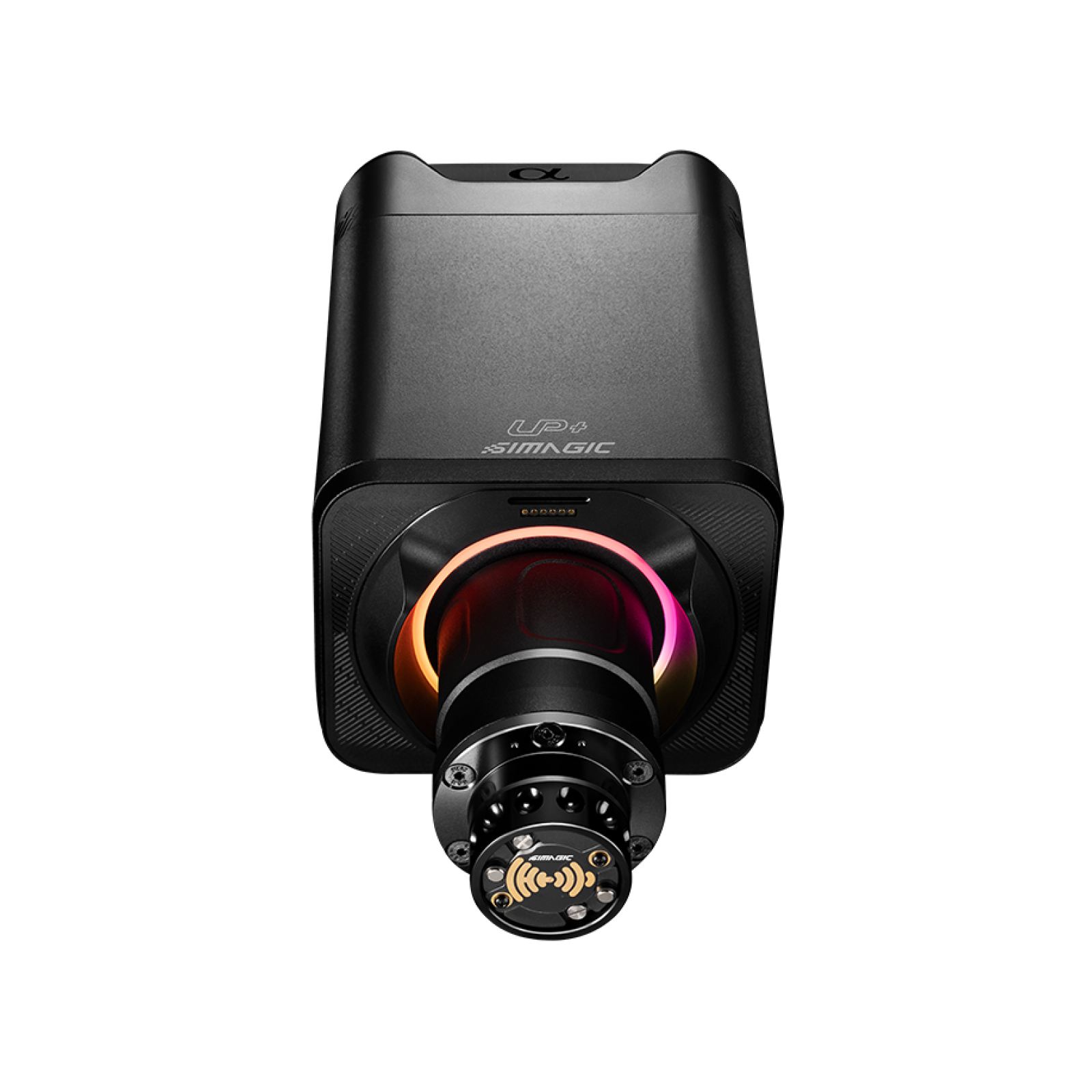
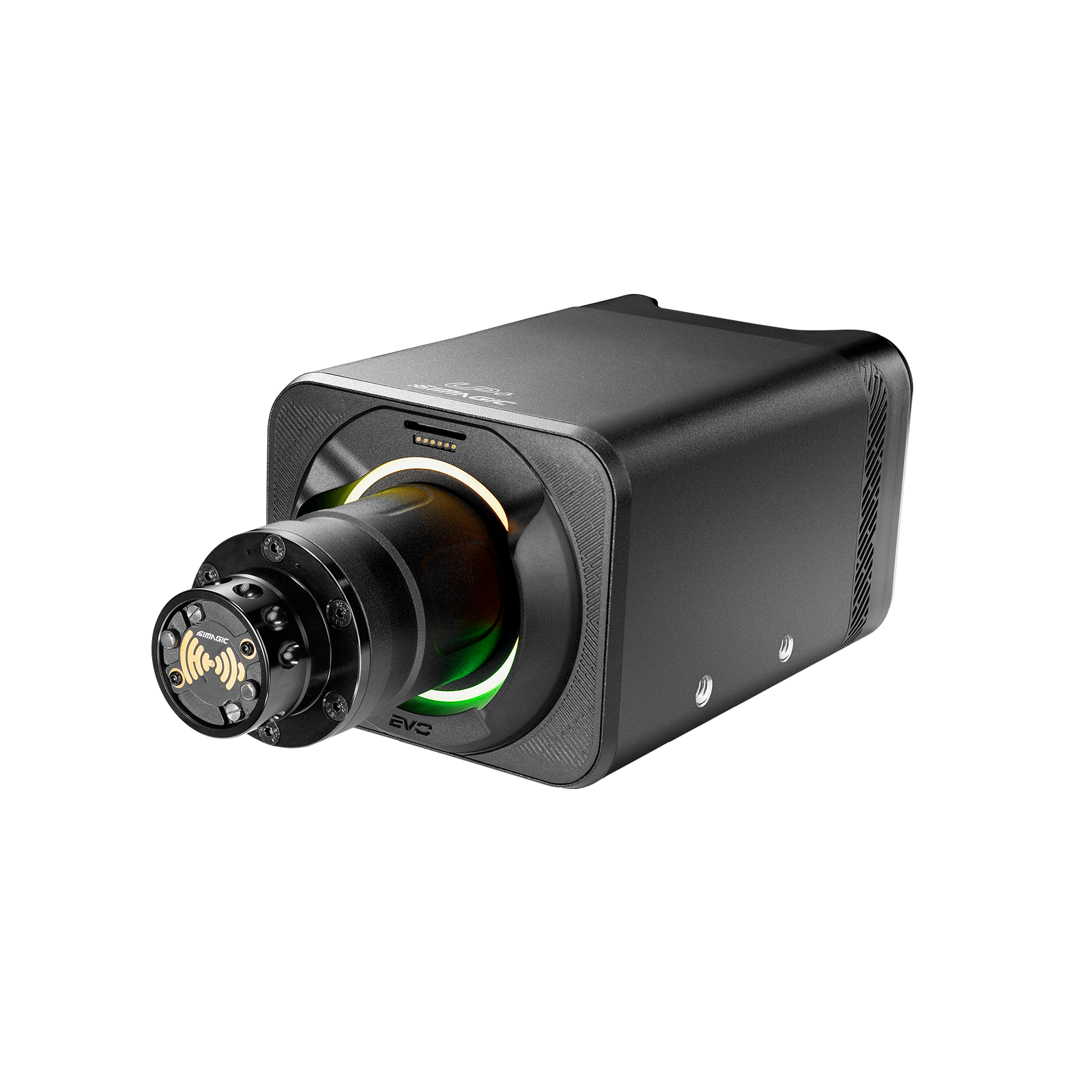
The housing is die-cast aluminium with CNC machining, measuring 130 x 110 x 281 mm and weighing 6,236 g. Reviewers who have opened these up describe clean internal cable routing and good PCB soldering, which is not a given at this price.
The panels are where the story gets less consistent. The front and rear faces are plastic, and some of the venting is styling rather than airflow. On a base marketed on its metal construction that is a fair thing to notice, though it is also a normal cost decision at $399 and it does not affect how the base drives.
Length is the more practical concern. At 281 mm the Evo is longer than several competitors, and combined with the width added by the front mount adapter, rig fitment deserves a tape measure before purchase rather than after.
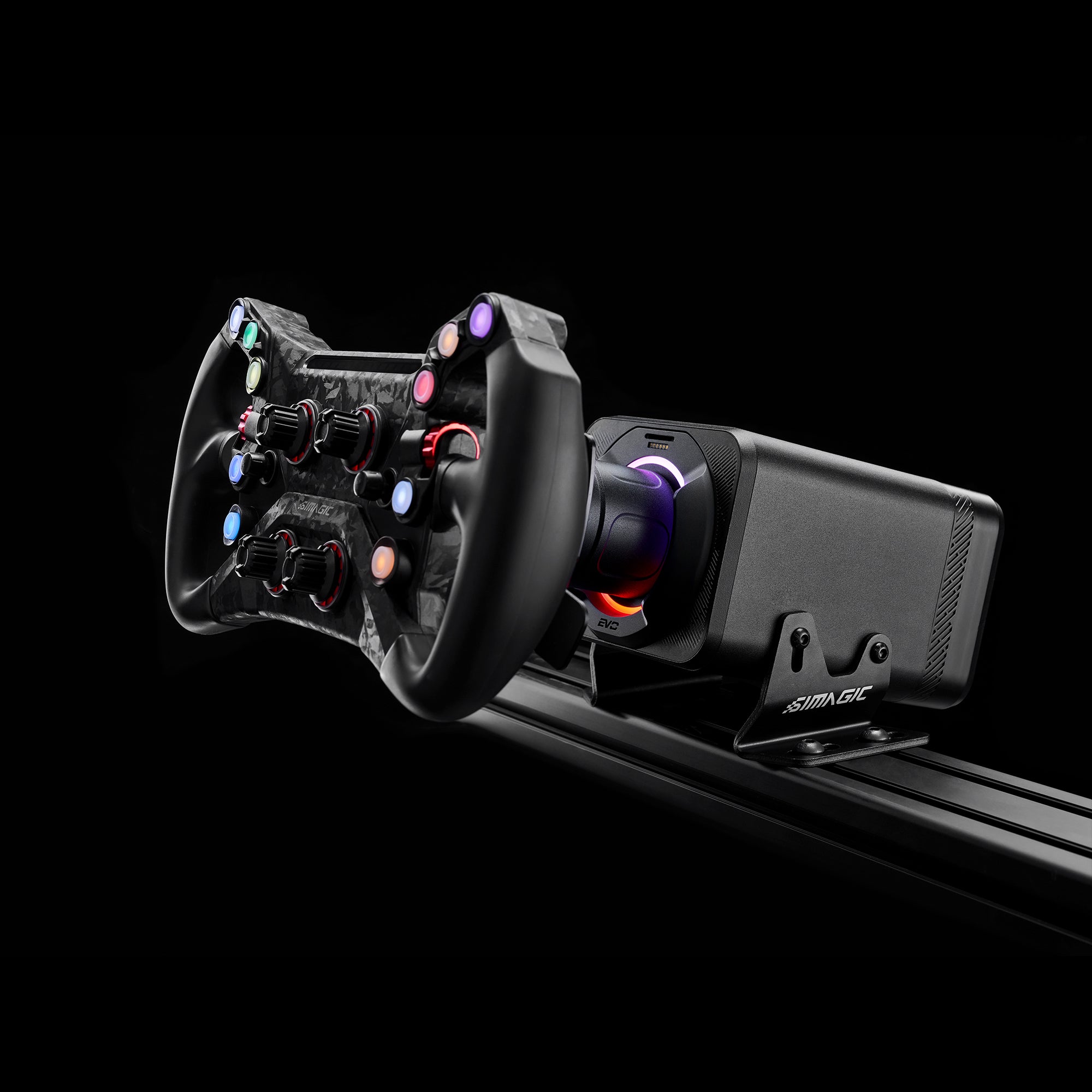
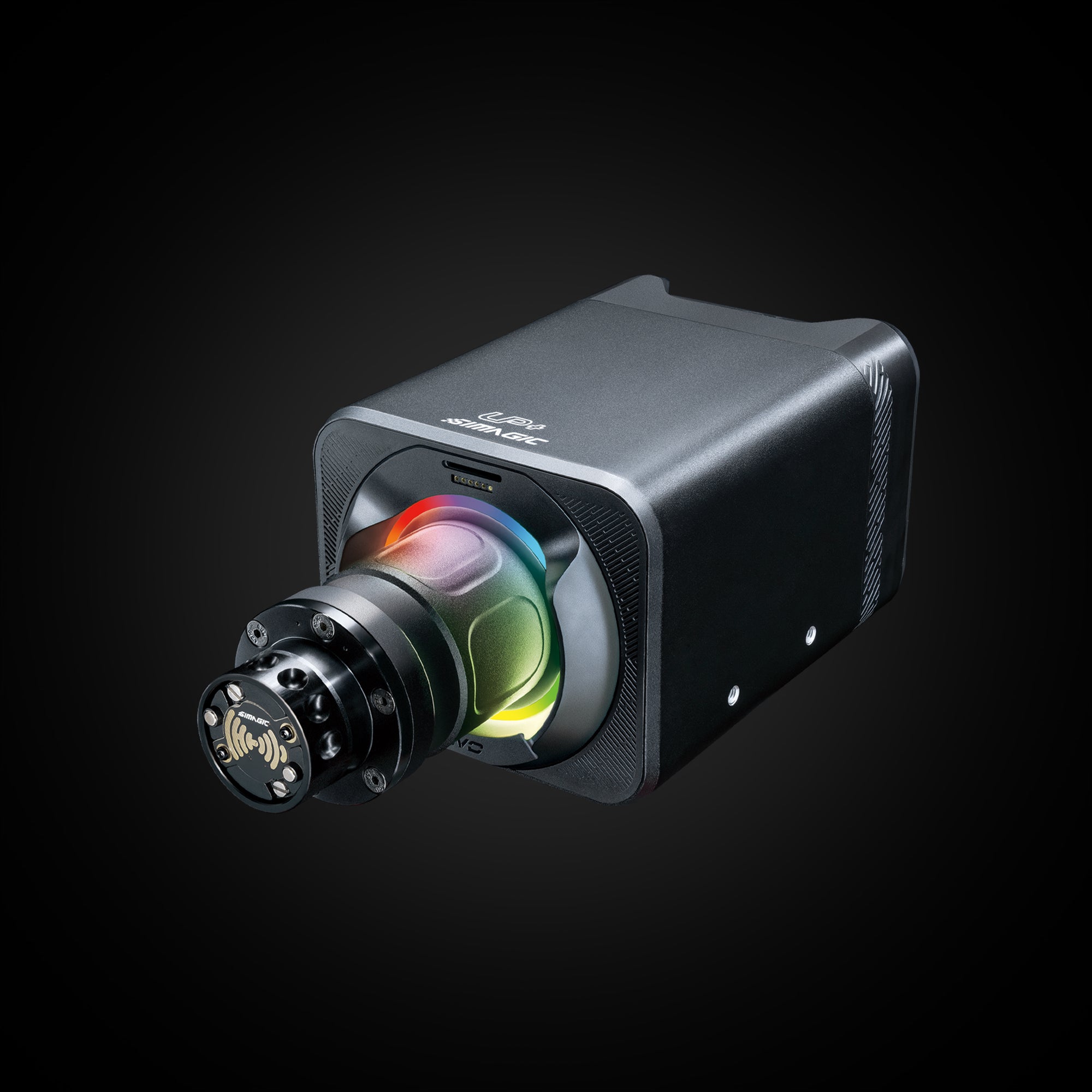
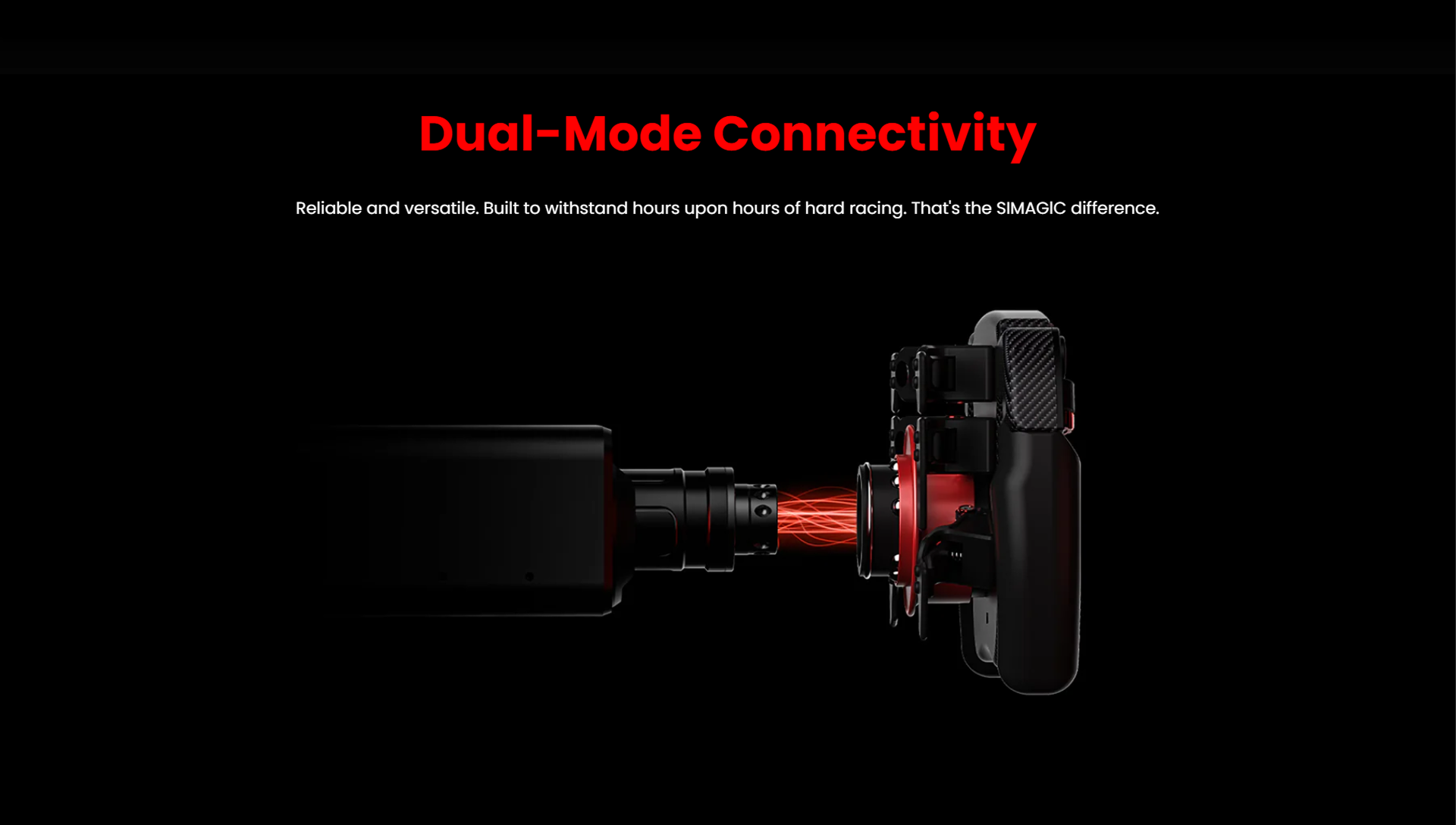
The quick release is described as having effectively zero flex, and it accepts SIMAGIC QR50, QR70 and QR-A. Third-party adapter support is there, with one caveat covered further down.
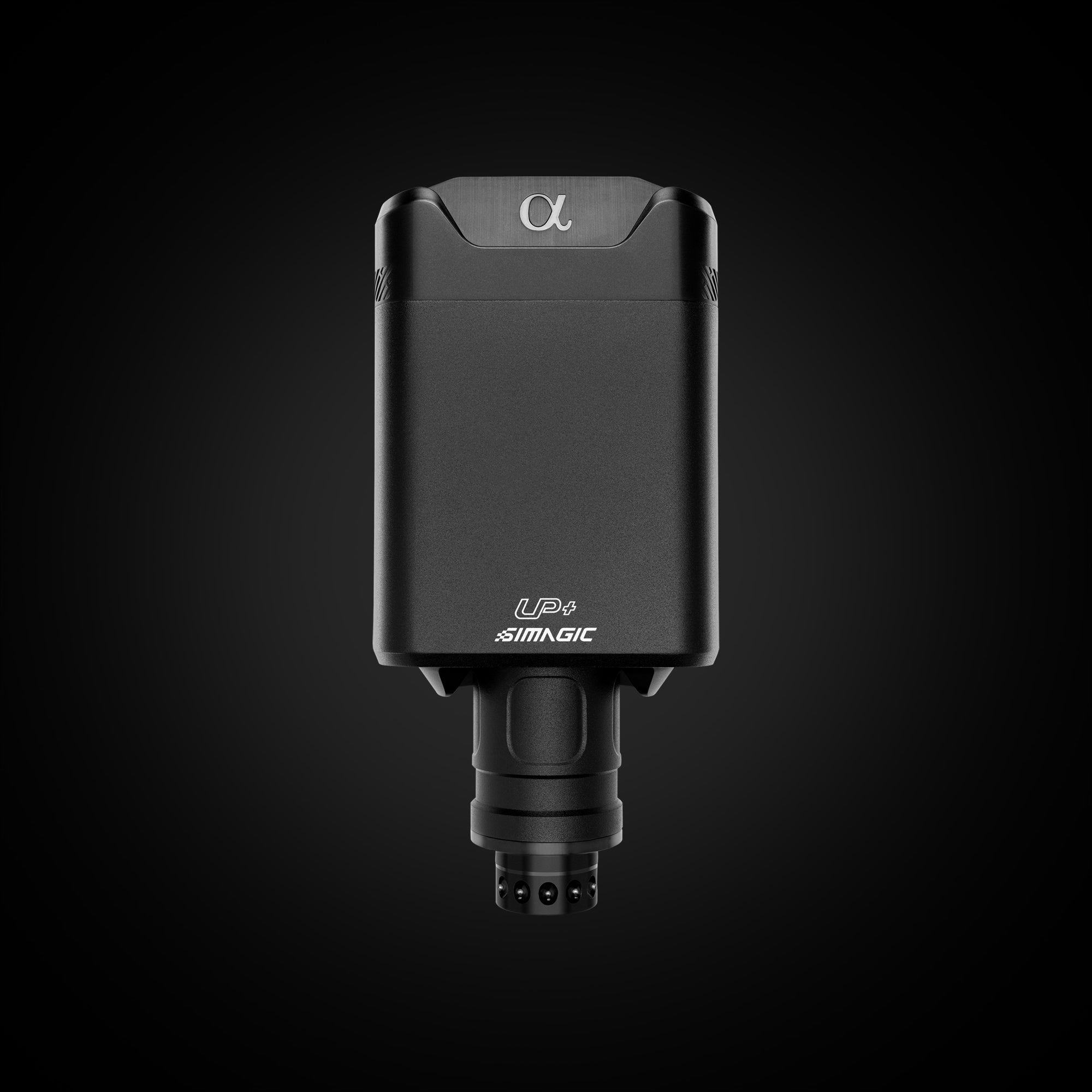
The rear panel carries 8 RJ ports and 3 USB ports, running CAN FD as the accessory protocol. That is a lot of expansion for a base at this money, and it is aimed at people who intend to add pedals, a handbrake, a shifter and a dash over time rather than buying everything at once.
The trade-off is the power button, which sits at the rear. Once the base is bolted into a cockpit with a wheel attached, reaching it is more awkward than it should be. Minor, but it is the kind of thing that gets noticed daily.

SimPro Manager is SIMAGIC’s control hub, and independent reviewers rate it well. The interface is described as balancing accessibility against depth, with clearly labelled settings, useful tooltips, and game-specific presets that are well judged straight out of the box.
The newer additions are dynamic prediction and adjustable filter levels, plus telemetry-driven control of the LED ring. For most people the presets are the right starting point and the deep settings can stay untouched.
The important caveat is firmware, and it deserves its own section rather than a footnote.
This is the part that does not appear in most reviews, because most reviews test a unit for a fixed window and move on.
There is a documented pattern of Alpha Evo Pro owners reporting significant noise and wheel wobble appearing after a firmware update, on units that behaved normally beforehand. The problem is well known enough that dedicated troubleshooting guides exist specifically for Alpha Evo Pro vibration and force feedback issues.
The reported fixes cluster around a few causes. Play in the quick release connector is a frequent culprit and produces vibration that gets blamed on the base. Cable checks, restarting the SIMAGIC management software, and cycling between default profiles resolve a meaningful share of cases. The power-on self test is best left to complete rather than interrupted.
Separately, there are community reports of game crashes tied to powering the base on during a session, with Le Mans Ultimate specifically named. Powering the base before launching the game avoids it.
None of this makes the Evo a bad base. Every direct drive manufacturer ships firmware regressions at some point. But a buyer should know that updating firmware here is not automatically a safe action, and that the fix path usually runs through the quick release rather than the motor.
The consistent finding across independent testing is that the Alpha Evo delivers force feedback quality above its price category, with reviewers placing it in the same discussion as more expensive bases from Simucube and Asetek.
Reported strengths are refinement around the steering centre and reduced graininess compared with the Alpha Mini it replaces. The smoother, higher-resolution feedback is the practical benefit of the 21-bit encoder and the low-inertia rotor working together.
It is worth noting where reviewers diverge on how much torque actually helps. Boosted Media’s comparative scoring put the Sport and standard Evo at the same force feedback quality rating, the Pro slightly ahead and described as the sweet spot of the range, and the 28 Nm Ultra only marginally ahead of the Pro while costing substantially more. The Ultra was also characterised as potentially over the top and hyperactive.
That is a useful corrective to the usual torque arms race. Going from 9 Nm to 18 Nm buys real headroom. Going from 18 Nm to 28 Nm mostly buys a bigger number, and the returns flatten hard.
Thermally the base holds up. Reviewers report it staying mildly warm through long sessions without throttling, helped by the blower-style cooling that stays quiet enough not to be a complaint.

Most reviews only tell you who should buy. This section matters more.
Console racers. The entire Alpha Evo range is PC only. If you race on PS5 or Xbox, stop reading and look at Fanatec or Thrustmaster instead. No firmware update is going to change this.
Anyone on a folding or wheel-stand rig buying the Pro. 18 Nm into a rig that flexes is wasted torque and an unpleasant experience. The Sport at 9 Nm is the honest choice for a wheel stand, and even that benefits from bracing.
Buyers who want everything in one box. The front mount is a separate purchase now. Factor it in or you will be waiting on a second delivery.
People who never touch settings and never want to. SimPro Manager presets are good, but this ecosystem rewards fiddling, and the firmware situation means occasional maintenance is part of ownership.
Anyone chasing the highest torque number for its own sake. The independent testing suggests the Pro is where the range peaks on value, and that the step to 28 Nm is not proportional to the price.
The base price is not the buy-in price. A realistic Evo build, using the 12 Nm variant as the middle case:
| Item | Typical cost | Note |
|---|---|---|
| Evo 12 Nm base | $549 | The advertised number |
| Front mount adapter | Extra | No longer included, price varies by region |
| Steering wheel | $200 to $800+ | Base ships without one |
| Pedals | $200 to $600 | Not included |
| Rig or stand | $300 to $1,500 | Must match the torque tier |
| Quick release (third-party wheels) | Extra | If not using SIMAGIC QR |
| Shipping and import duty | Varies | Significant outside the US and China |
The base is the good-value part of this equation. The surrounding kit is where budgets actually go, and a $399 Evo Sport on a $150 wheel stand with $80 pedals will feel worse than the price of the base suggests.
| Base | Torque | Price (USD) | Platforms | Notes |
|---|---|---|---|---|
| SIMAGIC Evo Sport | 9 Nm | $399 | PC | 21-bit encoder at an entry price, PC only |
| SIMAGIC Evo | 12 Nm | $549 | PC | The volume pick of the range |
| SIMAGIC Evo Pro | 18 Nm | $699 | PC | Rated the sweet spot by comparative testing |
| SIMAGIC Evo Ultra | 28 Nm | $969 | PC | Flagship, diminishing returns over the Pro |
| Fanatec ClubSport DD+ | High | Higher | PC, console | Console support is the deciding factor |
| MOZA R9 / R12 | 9 / 12 Nm | Comparable | PC | Direct rivals on price and torque, different ecosystem |
| Thrustmaster T598 | 5 Nm constant | $474 | PC, PlayStation | Axial flux, bundle includes rim and pedals, console capable |
The comparison that decides most purchases is not SIMAGIC against SIMAGIC. It is whether you need console support. If you do, the Evo is out regardless of how good the motor is, and something like the Thrustmaster T598 becomes the realistic option despite lower torque.
Against MOZA at similar torque and price, the choice comes down to ecosystem. Both companies sell wheels, pedals and dashes designed to work together. Buying a base is buying into the accessory catalogue behind it.

For a PC racer, yes, with the torque tier chosen honestly against the rig.
The Evo range does the thing that matters most in this category: it delivers detail rather than just strength. The 21-bit encoder and the low-inertia motor are not marketing lines, they are the reason independent testers keep comparing this base to hardware costing more. And SIMAGIC lowered the price while doing it.
The reservations are real but manageable. Plastic panels are cosmetic. The separate front mount is an annoyance and a small cost. The firmware pattern is the one that deserves genuine attention, and the practical advice is to not update reflexively, and to check the quick release first when something starts vibrating.
If you race on console, none of this applies to you, and no amount of force feedback quality changes that.
The pick, for most people, is the 12 Nm Evo. The Sport if the rig is light or the budget is tight. The Pro if you run formula cars on a rigid aluminium rig and know why you want the headroom.

Does the SIMAGIC Alpha Evo work on PS5 or Xbox?
No. The entire range is PC only, and there is no console-compatible variant. This is a hardware and licensing limitation, not something a firmware update will address.
Is the Alpha Evo a replacement for the older Alpha bases?
Yes, it is the successor generation. It replaces the Alpha and Alpha Mini with a new motor design, a 21-bit encoder in place of 18-bit, and lower pricing.
Should I upgrade from an Alpha Mini?
Reviewers who tested both concluded the upgrade is not essential. The Evo is better, but an Alpha Mini owner is not missing something fundamental. If your Mini works, the money is better spent on pedals or a rig.
Which torque variant should I buy?
9 Nm for a wheel stand or a first base. 12 Nm as the general-purpose choice. 18 Nm for formula and prototype cars on a rigid rig. Comparative testing rated the 18 Nm Pro as the range’s best balance, and the 28 Nm Ultra as offering diminishing returns for the extra outlay.
Is the front mount included?
No. SIMAGIC moved it to a separate accessory for this generation. Budget for it, and check clearance, because the adapter adds width that can cause fitment problems on tighter rigs.
Why is my Alpha Evo vibrating or making noise?
The most common reported cause is play in the quick release rather than a fault in the base. Reports also cluster around firmware updates introducing the behaviour. Check the QR connection and cabling first, restart the SIMAGIC software, and try cycling between default profiles before assuming hardware failure.
Does it support iRacing at 360 Hz?
Yes, 360 Hz iRacing support is one of the range’s stated features, alongside a 20 kHz internal refresh rate and a 180 MHz processor.
Can I use third-party steering wheels?
Yes, via QR50, QR70 or QR-A, and third-party adapters are supported. The caveat is that QR-A passthrough has power limits, and wheels with integrated screens can exceed them.
How loud is the cooling?
Reviewers describe the blower-style active cooling as quiet, with no noise complaints recorded during testing. It holds temperature through extended sessions.
How many accessories can I connect?
The rear panel carries 8 RJ ports and 3 USB ports over CAN FD, which is generous for the price bracket and aimed at incremental ecosystem building.
| Specification | Detail |
|---|---|
| Torque (variants) | 9 Nm / 12 Nm / 18 Nm (28 Nm Ultra sold separately) |
| Motor | Custom 5-pole ultra-low-inertia servo, zero-cogging design |
| Encoder | 21-bit |
| Processor | 180 MHz |
| Internal refresh rate | 20 kHz |
| iRacing support | 360 Hz |
| Housing | Die-cast aluminium, CNC machined, plastic front and rear panels |
| Dimensions | 130 x 110 x 281 mm |
| Weight | 6,236 g |
| Quick release | SIMAGIC QR50, QR70, QR-A |
| Rear connectivity | 8 x RJ, 3 x USB |
| Accessory protocol | CAN FD |
| Cooling | Active blower-style |
| Lighting | Customisable RGB collar with telemetry support |
| Platform support | PC only |
| Software | SimPro Manager |
| Front mount | Sold separately |
Reviews on WheelVerdict are written by our editorial team. They are built from published independent testing, manufacturer documentation and owner reports rather than sponsored sample loans, and every review states which sources informed it. We do not accept payment for scores.
Product images courtesy of SIMAGIC.
Affiliate disclosure: WheelVerdict may earn a commission on purchases made through links on this page, at no additional cost to you. Commission does not influence scoring. This review is based on published independent testing and manufacturer documentation, not on a manufacturer-supplied sample.
Pricing last verified 5 September 2026.
SIMAGIC P1000 Pedals Review: A Twelfth of the Price of an Active Pedal
Sim-Lab XB1 Handbrake Review: 150 kg of Load Cell, Straight Into USB
Sim-Lab SQ1 Shifter Review: Four Rollers, One Very Deliberate Clack